
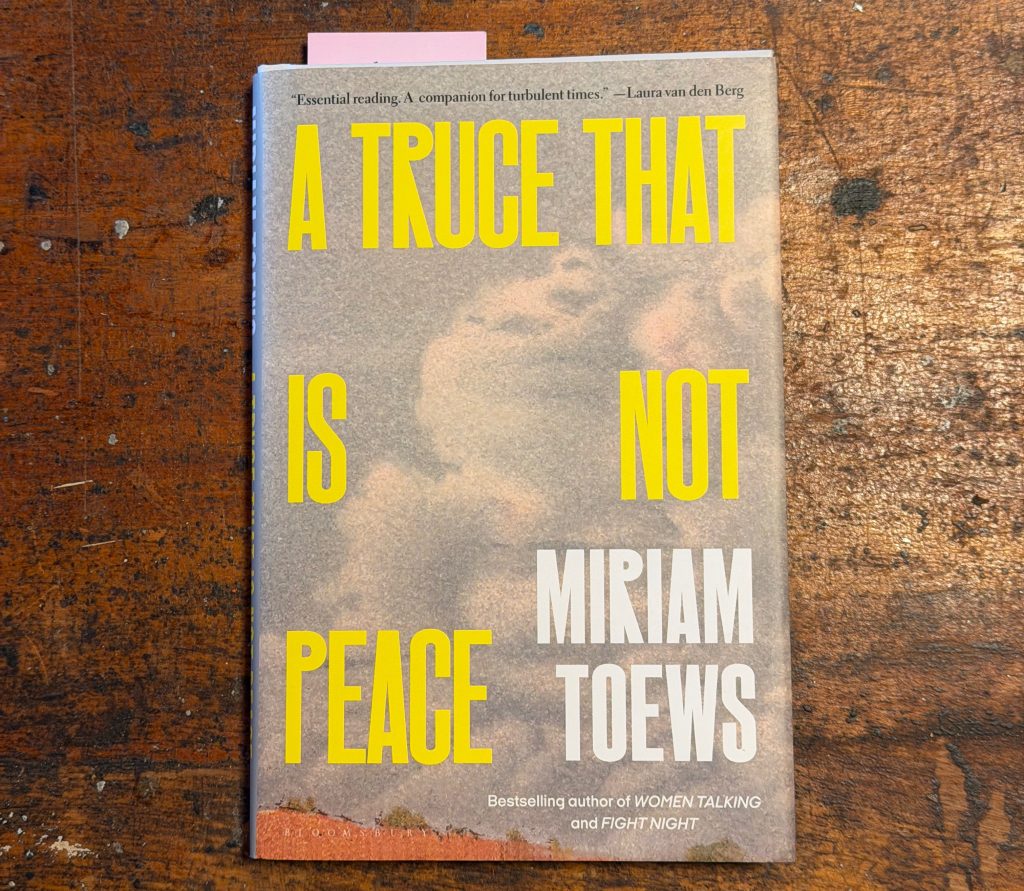
Over the course of a few midwinter weeks, during which I quote unquote “had” to read two other wintry books in time for book club meetings (The Left Hand of Darkness by Ursula K. Le Guin, which takes place on an icy planet known on other planets as Winter, and The Land in Winter by Andrew Miller, which has winter in the title as you can see), I read A Truce That is Not Peace in furtive sips. Sometimes these were sips of icy champagne, sometimes rich, hot broth, by which I mean Toews offers, by turns, the two things I crave in winter: fizzy delight and warming sustenance, in pretty equal measure. The writing is funny, really funny (champagne), with the kind of humor that comes, not from the intellect or the wit, but from the bottomless pain (winter) that form the axes around which the book spins: the suicides of her father and, almost exactly twelve years later, her sister. And the broth: Toews writes of her family members, living and dead, with real respect and deep love.
And though I was always jonesing for A Truce while I read the other books, it’s probably for the best to savor it, though its length would permit just one long session of reading. Much of the nonlinear book comprises short passages, sometimes just a Chekhov or Robert Walser quote, or a letter, or a longer, more developed story. Most of the passages are separated by space and a small icon of two wavy lines which can be interpreted as a little gust of wind. In the longest section of the book, the icon changes to a single gust to separate each in a series of letters written to her sister from a disastrous tour of Europe.
In the first section, Toews introduces tropes or anecdotes that she returns to repeatedly in the rest of the book. Among them:
- a series of failed answers to the question Why do I write? (a failure that ultimately gets her disinvited to a literary event in Mexico where she was asked to share her writing on that subject)
- correspondence with her sister, Marjorie, with whom she’s made a deal, perhaps the truce of the title: “You live. And I’ll write.”
- funny, poignant notes about the antics of her grandkids, her own childhood hijinks, and a deranged skunk who keeps getting trapped in the window well
- a gruesome recurring dream: “I’m being shot in the face at close range and my mouth is flying off down some white corridor, and I’m so angry with myself for not getting out of the way in time.”
- musings about the wind museum that she imagines creating
Here’s a passage I kept reading aloud to anybody who would listen, during the time I carried the book everywhere, even when I knew I wouldn’t really have time to read:
These days, my two youngest grandchildren have the habit of biting their mothers, and in some instances, other children. My daughter and daughter-in-law texted me photos of the bite marks, some taken by themselves and some by concerned daycare workers. My daughters are worried about the biting, but also worried because babies who bite are not allowed to attend daycare. And if that were to happen, my daughters would lose their fucking minds.
When I saw the photos, I texted back that it was good to know my grandkids were biting other kids, not themselves. I’ve received no response.
Relatable humor, but laced with something more potent. Toews writes the way a skilled cook prepares pufferfish: delicate, uncommonly sweet, in less sure hands it would take us down entirely.
In other sections, the darkness is more pervasive, but it’s always tinged with the characteristic mirth. There’s a 2022 email from her elderly mother, writing from the hospital about major bleeding episode she experienced at 2am:
After what seemed like a lengthy wait the nurse arrived, looked at me and said, Oh. First order of the day was to clean up the blood. Then eventually she got to me. Calmly cleaned up my bed, then my vein line, gave me a chance to go pee and got me back into bed. Another nurse came along to check my b.p. Said, Don’t laugh, finally got a reading, just a little high. I went back to sleep, and she went back to her desk. Well, here I am right as rain and ready for a few day.
P.S. It really was funny. You just stay where you are and enjoy it. I’ll definitely let you know as soon as I know if anything develops.
Hey, I love you! Have fun. Chow!”
Mom
This outrageous line – “First order of the day was to clean up the blood.” – haunts the book, but also echoing throughout is her mother’s laughter. Her laughter is contagious. She’s the first to laugh when the family gets stranded on an uninhabited island, and then so does everybody else in turn. She makes “whooping sounds of joy” at the sheer destruction caused by her baby great-grandson as he bounces and screams and pushes her bedside panic button, and then gets Toews’s daughter, the baby, and the cleaning lady laughing, too.
Her heroic mom! Toews delights in her mom, she loves and respects and treasures her. This attitude toward a parent in a memoir, especially a trauma memoir, is, in all my reading at least, unique. Their relationship can’t have been wholly uncomplicated, especially given their shared losses, but Toews is unflaggingly admiring and tender in her portrayal of her mother. As a general rule, memoirists or personal essayists shouldn’t characterize themselves as the hero or the victims. Toews doesn’t come close to either sin, and leaves room instead for her mom to be the hero.
Her mother is the heroic title “she” in the New Yorker essay “The Way She Closed the Door,” which preceded the book and appears in an adapted form as a centerpiece. I read the essay first and urge you to do the same. It has a really cool storytelling frame that Toews rightly omits in the book, and I found great pleasure in returning to the New Yorker piece after reading the first half of the book and getting to know Toews’s mother better. She provides, at great risk to her own safety, a safe house for Mennonite women fleeing their community, she hosts young Chinese men whom she’d never met in her home for Scrabble tournaments, and she replies with what could be irritating mildness to Miriam’s anguish over frightening experiences (a ship violently rocking: “Well, honey, we’re on a boat.” A plane flying barely above Miriam’s car in a blizzard: “That’s winter driving for you.) Her laconic lines are a joy: “Don’t be alarmed if I scream in my sleep,” she tells Miriam’s son-in-law. And, most of all, she laughs.
The pain that she somehow laughs through always hovers, of course. In the last pages of the book, Toews writes,
Every two or three months I need to affirm a narrative for my mother: that she was not a failure, that she did everything she could, that she couldn’t have saved my father and my sister in the end, that she had to survive and remain and breathe, for the rest of us, for herself, for me.
By this point, I found myself joining Toews in wanting to reassure her mother, even as Toews follows these lines with, “But of course, this narrative is not necessarily true. What’s true is that she chose to remain.” For even as the reader joins Toews in admiring and caring deeply for her mother, it’s Toews that we are really here for, hero or not. It’s her endless loop–why I write, clean up the blood, the skunk, the wind museum–that plays now in our head, too. This is the real gift: we not only identify with Toews, on this elliptical journey through grief, ringing with laughter, but we also, though her example, search within ourselves for the kind of spangled grace she offers to those who failed her, those who chose to leave and those who chose to remain.